Most people ordering a custom suit jacket learn two numbers early: a Super count printed on the swatch, and a price. The Super count gets treated as a quality score, higher is better, and the decision stops there. That is the wrong reading. The Super number describes one narrow property of the yarn, the weight describes how the finished jacket will actually behave on a body, and the weave decides how it holds a press and survives a week of wear. For corporate, hospitality, and club or school jackets, the cloth that performs is usually not the one with the highest number on the tag.
This is a plain-language walk through the three specs that appear on every cloth description, what each one really tells you, and how to weigh them for an order that has to look right and last. The figures below are industry-standard ranges, not guarantees for any specific mill or bunch.
What the Super number actually measures
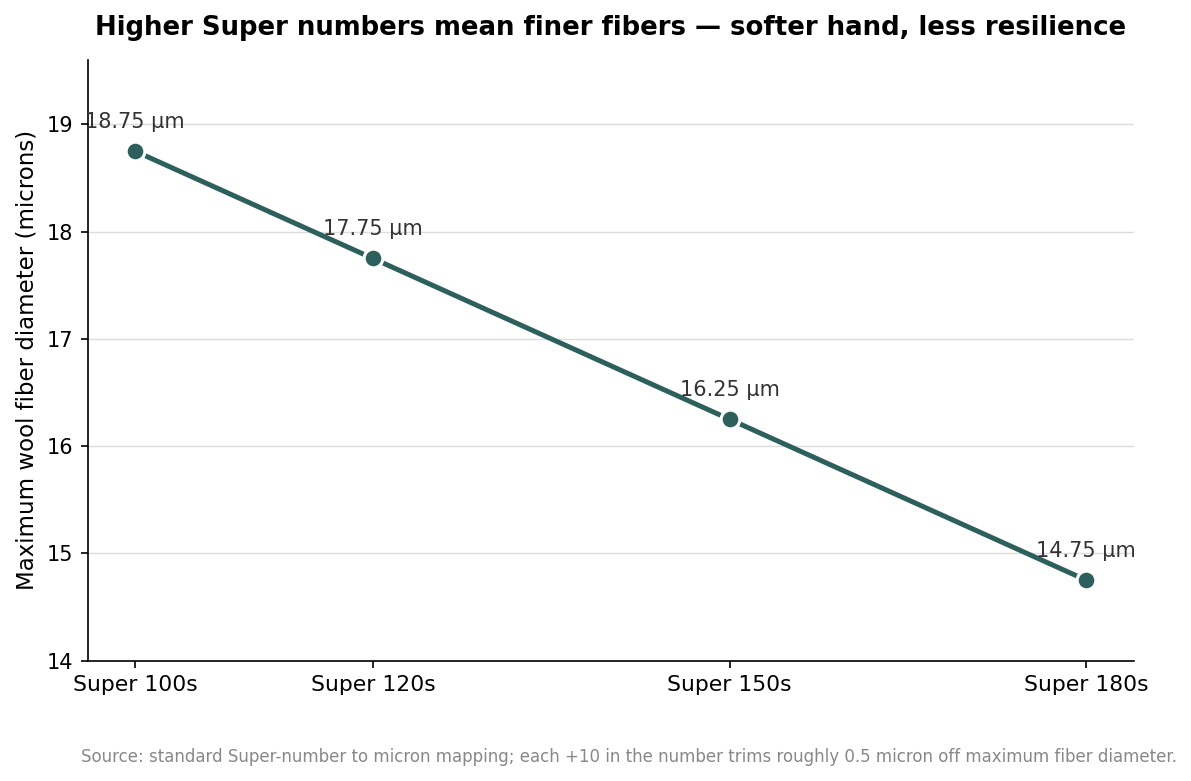
The Super number is a measure of fiber fineness, and only that. It maps to the maximum average diameter of the wool fibers in the yarn, in microns. A Super 100s cloth is spun from wool no coarser than about 18.75 microns; Super 120s sits near 17.75; Super 150s around 16.25; and Super 180s down near 14.75. Every ten points on the scale shaves off roughly half a micron. Finer fiber feels softer in the hand and takes a cleaner, more lustrous finish, which is why high numbers command high prices.
The catch is that fineness and durability pull in opposite directions. The same thin fibers that give a Super 150s its liquid drape also snag, shine, and break down faster than a sturdier Super 100s, and a snag in a very fine cloth is much harder to repair invisibly. For a jacket that gets worn daily, packed into a car, or issued across a team that will not baby it, a Super 100s to 110s is usually the smarter buy than a 150s. Save the high numbers for occasion wear that spends most of its life on a hanger.
Weight is the spec that decides how it wears
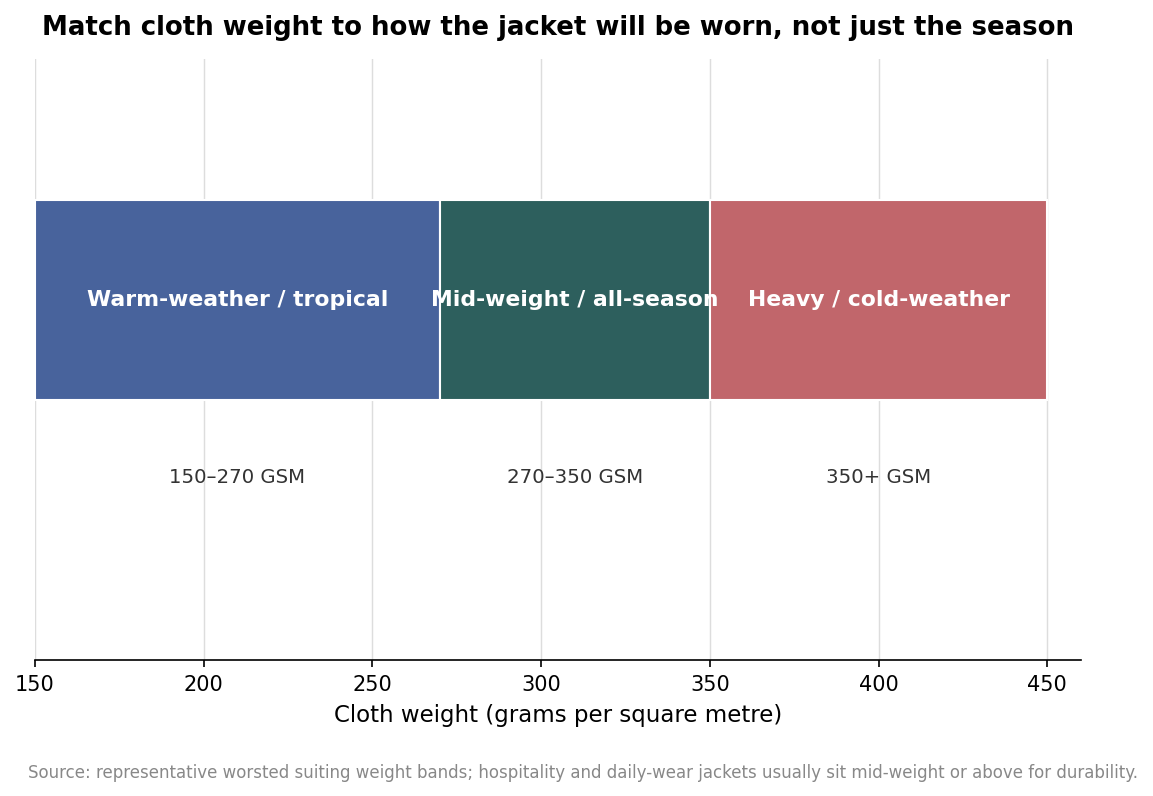
If you only look at one number, look at weight, expressed in grams per square metre. It governs drape, wrinkle recovery, structure through the shoulders, and how warm the jacket runs, all things the wearer notices every hour. Warm-weather and tropical cloths run roughly 150 to 270 GSM and breathe well but crease easily and can look flimsy on a structured jacket. Mid-weight, year-round cloths sit around 270 to 350 GSM and are the safe default for most business and uniform jackets because they hold a line and recover from wrinkles. Beyond 350 GSM you are into cold-weather cloth with real body and a heavier hand.
Weight matters more than season for a working jacket. A hospitality or front-of-house jacket worn through long shifts wants mid-weight or heavier so it keeps its shape and hides wear, even in a warm room, because a featherweight tropical will look tired by mid-service. A summer event blazer that only comes out occasionally can go lighter. Decide by use first, then trim for climate.
Weave and finish: worsted, hopsack, twill
Two cloths at the same Super number and weight can wear completely differently depending on how they are spun and woven. Worsted wool, combed smooth and tightly woven, gives the crisp, slightly formal surface most business suits use; it presses sharply and resists wrinkling. Woolen-spun cloth, lofted and fuzzier, reads more casual and insulates better but bags more easily at the elbows and seat. Among worsteds, a plain weave is smooth and formal, a twill shows a diagonal rib and hides creases well, and a hopsack has an open basket weave that breathes and shrugs off wrinkles but can catch on rings and Velcro, a real consideration for hospitality staff.
Finish is the quiet variable. A high-twist yarn resists wrinkling and travels well, which is why it suits jackets that get packed and re-worn, while a softer finish feels nicer but marks more. If a jacket will be worn hard, ask specifically about twist and weave, not just the Super number, because those are what determine whether it still looks sharp at the end of a shift.
Blends for corporate and hospitality wear
Pure wool is the benchmark for hand and breathability, but it is not always the right answer for a uniform program. A wool-polyester blend, often somewhere around a two-thirds to one-third split, trades a little breathability for markedly better wrinkle recovery, shape retention, and resistance to shine at stress points. For a team that will not dry-clean on schedule, that trade is usually worth it. A touch of elastane adds stretch for roles with a lot of movement, and mohair blended into wool boosts resilience and gives a cool, crisp hand for warm venues.
The mistake to avoid is speccing a luxury pure-wool high-Super cloth for a role that needs a workhorse. Match the fiber content to the laundering reality and the daily abuse the jacket will take. A slightly less romantic blend that still looks sharp after fifty wears beats a beautiful cloth that pills and shines after ten.
Reading a cloth spec before you commit
Put the three numbers together and a cloth description stops being marketing and becomes a prediction. A Super 130s at 260 GSM in a soft finish is a comfortable, good-looking occasion cloth that will not love daily wear. A Super 100s at 300 GSM in a high-twist twill is an unglamorous spec that will hold a press, resist wrinkles, and survive a uniform program for years. Neither is better in the abstract; they answer different questions.
Before approving cloth for a run, get a physical swatch, not a screen image, and handle it the way the jacket will be handled: scrunch it in your fist and watch how fast the wrinkles fall out, hold it to the light to judge weight and openness, and rub the surface to see whether it shines. If the order is for a team, confirm the same bunch and dye lot will cover the whole quantity, because natural cloth varies between lots and a rematch mid-run is where color drift creeps in. Read the spec, handle the cloth, and the jacket will wear the way you expected instead of surprising you three months in.