Two jackets can hang on the same rail in the same fabric, cut to the same measurements, and cost wildly different amounts — and the reason is usually hidden inside the chest where no buyer can see it. That hidden layer is the canvas, the internal structure that decides whether a jacket drapes and molds to a body over years of wear or slowly bubbles, stiffens, and gives up. If you are ordering custom or made-to-measure jackets, construction is the single spec that most affects how they age, and it is the one most often left off the quote. Here is what the three constructions actually are, how to verify what you are being sold, and how to choose.
What the canvas is, and why it matters
Inside the front of a tailored jacket sits an interlining that gives the chest and lapels their shape. In a well-made jacket that interlining is a sewn canvas — traditionally a blend of wool and horsehair, sometimes camel hair — floated between the outer shell and the lining and attached with loose stitching. Because it is stitched rather than glued, the canvas can move independently of the outer cloth. It works like a flexible skeleton: it holds a clean line across the chest while letting the fabric flex at the shoulders and elbows, and over time the wool and horsehair mold to the wearer, so the jacket fits better the more it is worn.
The cheaper alternative replaces that sewn layer with a fusible interlining — a sheet backed with heat-activated adhesive that is pressed, or “fused,” directly to the wool shell. It is fast, needs little skill, and produces a crisp result off the press. The problem is the glue. Over years of wear, and faster with repeated dry cleaning, the bond can break down, and the shell separates from the interlining in ripples across the chest and lapels. That is delamination, commonly called bubbling, and once it starts it cannot be pressed out for good. It is a different failure from a chest that bubbles because the jacket is simply cut too tight — this one is baked into the construction.
Full canvas, half canvas, and fused
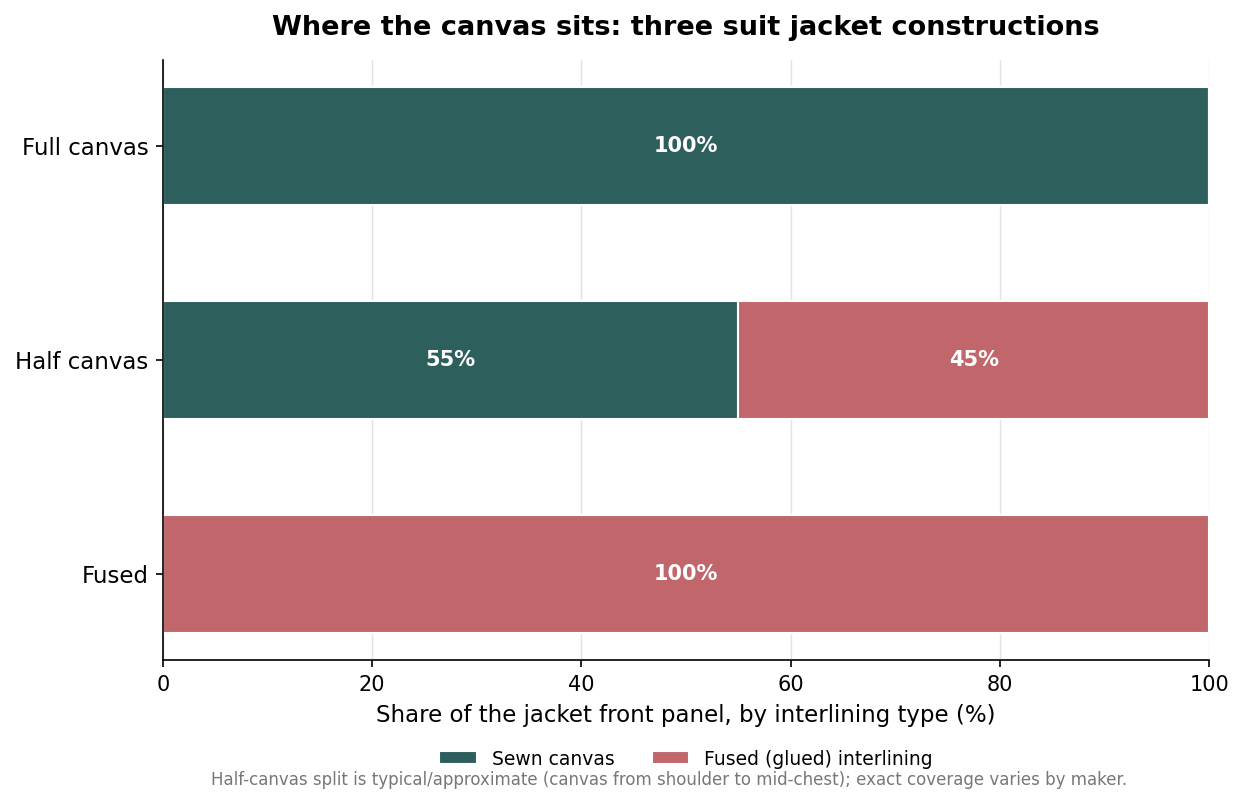
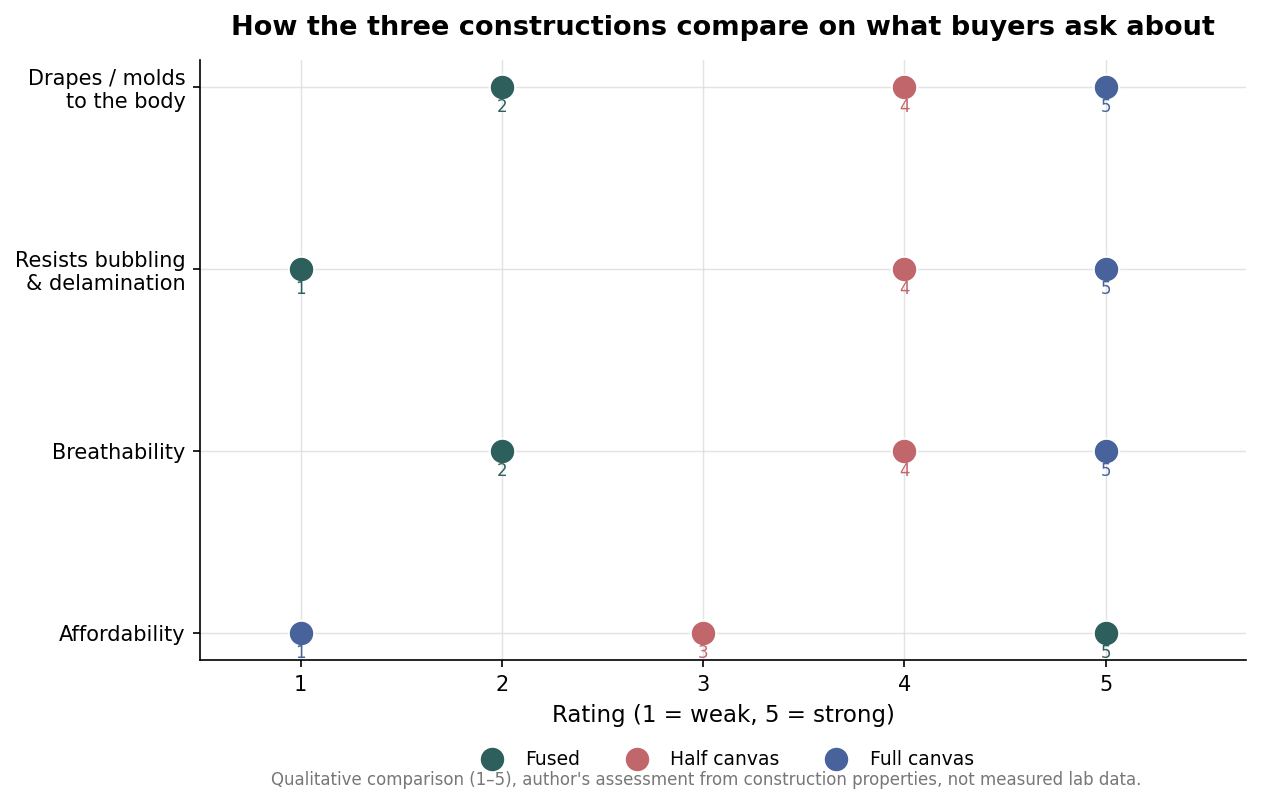
Full-canvas construction runs the sewn canvas through the entire front of the jacket, from the shoulders all the way down to the hem, plus the lapels. It is the most labor-intensive make because most of that canvas is attached by hand, and it is the most expensive. In return it gives the best drape, molds most fully to the body, and carries no risk of delamination because there is no glue holding the structure together.
Half-canvas is the pragmatic middle. Sewn canvas covers the upper portion of the jacket — roughly from the shoulders down through the chest to about the mid-point — where structure and drape matter most, while a fusible interlining handles the lower front where it barely shows. You get most of the benefit of canvassing, including a natural chest and lapel roll, at a meaningfully lower cost, and the vulnerable glued section sits below the chest where stress and visibility are both lower. For most corporate, hospitality, and event orders, half-canvas is the sensible default.
Fused jackets use glued interlining throughout, with no sewn canvas at all. They are the most affordable and perfectly serviceable for short-term or budget needs — a one-season uniform, a large low-cost run, a jacket that will not see heavy wear or frequent cleaning. The compromises are a stiffer, flatter chest that never quite molds to the wearer and the long-term delamination risk. If a program expects garments to last several years and be cleaned often, fused is a false economy.
How to verify what you are actually buying
Because the canvas is invisible from the outside, the construction named on a quote is easy to overstate, so it helps to check. The classic method is the pinch test: near the lowest buttonhole, pinch the outer fabric and the lining apart from each other and roll them between your fingers. If you can feel a distinct third layer floating loose between the shell and the lining, canvas runs to that point, which indicates full-canvas down low. If the two layers feel welded into a single stiff sheet with nothing floating between them, that area is fused. Pinch high on the chest as well as low: feeling a floating layer up top but a bonded one down below is the signature of half-canvas.
Treat the pinch test as a strong hint rather than a lab result, because canvas thickness and placement vary between makers and a light canvas can be hard to feel. The more reliable move is to make construction an explicit line on the specification — state full, half, or fused in writing — and, for a large program, to cut one sample jacket open or ask the supplier to. A maker confident in their construction will not object to either.
Choosing for the job in front of you
Match the construction to how the jacket will live. For frontline hospitality and retail uniforms that are worn daily and cleaned constantly, half-canvas is usually the best value: it survives the wear and cleaning that would delaminate a fused jacket, without the cost of full canvas. For executive, client-facing, and ceremonial wear where the garment represents the organization for years and appearance is paramount, full-canvas earns its premium through drape and longevity. For short-run event jackets, one-season programs, or tight budgets, fused is a legitimate choice as long as everyone understands it is built for the near term, not the long haul. On price, expect the three tiers to rise in that order — fused lowest, half-canvas in the middle, full-canvas the premium — with the gap driven mostly by hand labor rather than materials. Decide the construction first, put it in writing, and the jacket will age the way you expect rather than the way the glue decides.